Note: I used (a slightly different version of ) this story as my admission essay for Carnegie Mellon. They accepted me, so I assume that this story is sufficiently interesting for a blog.
In Spring of 1999 I was 14; I lived in Maine and my dad lived in Panama City, FL. My parents have lived in very different parts of the country since I was 3, so as an only child, I was a veteran of traveling alone by a very young age. (Fun fact: I lost my first tooth while flying alone from Seattle to Honolulu.)
As a seasoned traveler, I knew the ins and outs of airports, flight transfers, etc. My parents had enough faith in my ability to get myself across the country that they didn't feel the need to hold my hand while doing so. Assuming this trip would be no different than the hundreds of other flights I'd been on, my mom also took off to visit a friend across the country. So, we both left the airport at the same time, just headed to different destinations.
This flight was in the evening and everything was going as planned until I arrived in Memphis. Ready to be in Florida in an hour and a half, I strutted down the terminal to the gate of my next flight. But when I got to the gate, I saw that my flight had been canceled. This was somewhat distressing, but like I mentioned before, I knew how to handle these kinds of situations. So I walked to the ticketing agent and confidently asked for a ticket on the next flight, assuming it would be an hour or two from that point. No dice. The next flight was not until 7am the next day.
So okay, this was a new one for me while traveling alone, but I'd been in this situation before on family vacations. I told the agent that 7am was fine, and could I please have a hotel voucher, since the flight cancellation required me to stay overnight?
She just stared at me and asked if I was 18, though it was pretty obvious that I was not. She informed me that they weren't legally allowed to give hotel vouchers to anyone under 18. Well crap.
Starting to get worried, I asked her what she expected me to do? I didn't live in Memphis and certainly wasn't going to sleep in the creepy, abandoned airport by myself all night. She was understandably made extremely uncomfortable by this situation and went in the back to talk to her manager. After an eternity of wondering if I was going to have to sleep on the airport floor, she reemerged and asked me to come hang out in the Northwest Airlines (yeah, I'll name names) office while they figured out what to do with me.
So I headed back to the employee area and they were very nice to me. They gave me cookies and meal vouchers that I couldn't use because all the food places were already closed. Since this was pre-cell phone age, I also used their phone to alert my dad to the fact that I wasn't going to arrive on time. Or even that night. I don't really remember how that conversation went, but my dad didn't seemed overly distraught by the fact that I was 14 and stuck in an airport overnight by myself. I guess that's what happens when you're a truly grizzled traveler growing up in a military family.
It was after midnight by the time they figured out what to do with me. After presumably making a whole lot of panicked phone calls to Northwest Airlines headquarters, they came to the conclusion that it would be okay and legal to keep me in the hotel attached to the airport. I was really tired, so this was amenable to me. That is, until I actually saw it.
I've stayed in a lot of motels in my life, since my family travels a lot. This was worse than any of them. By far. It was dark, grungy and smelly, and the employee who accompanied me to the room inspected the closet and under the bed, just to make sure no one was hiding in there. Was that supposed to be comforting in some way? This whole situation did not instill a lot of confidence in me. Nor did the stain that looked suspiciously like blood right by my door. I was pretty sure this was where I was going to die.
I really had no idea what to do all night. If I fell asleep, someone would definitely break in and kill me. But I was also really, really tired. Since my luggage was presumably in a nicer location than I was, I didn't have any clothes to change into, or a toothbrush, or any of my stuff.
Fortunately I had my CD player to keep me entertained, and to block out some of the noises coming from the hallway and rooms near me (which clearly had no sound-proofing). I really wanted to call my mom, but she was still on a plane and couldn't hear about this until the next day. So I just laid there on the bed, awake almost the entire night, positive that every sound was an intruder coming to murder me. There was even a skylight in the room, yet another entry route for deranged Memphis killers to come and get me. How was this the safest option for a 14-year-old girl?
I must have eventually fallen asleep, because I awoke to my alarm clock and booked it the hell out of there. My 7am flight left as scheduled and, amazingly, both my luggage and I arrived in Panama City, FL completely unscathed. And with an awesome story.
Another note: Not long after this event, TSA issued a new policy that unaccompanied minors are not allowed to fly on the last flight of the night. I'd like to think I was involved in the birth of that policy.
Saturday, October 9, 2010

Tuesday, October 5, 2010
Gigapan
Gigapan was the second project I worked on at the CMU Robotics Institute. My team comprised several unfathomably brilliant scientists and me. For instance, the person who interviewed me for my job? Turns out he's the head of robotics at NASA Ames. Thank goodness I didn't know that at the time.
So, the idea behind the Gigapan was to allow anyone with a digital camera to (affordably) take massive-scale panoramas without requiring any extensive knowledge. Basically you'd be able to plunk your camera onto the Gigapan, set the four corners of the desired panorama and it would snap all the necessary pictures for you. After uploading them to your computer, it would then automatically stitch the pictures together and spit out an awesome multi-gigapixel panoramic image. That is, in fact, how it works now; however, when I worked on the project, it was still in alpha mode and did not perform quite as nicely.
My role in all this was to alpha-test the heck out of the Gigapan. Why they chose me for the position is a mystery for the ages, but nevertheless I used my nebulous skill set to go out and take a crap ton of panoramas around Pittsburgh.
There are a lot of elements to taking a good panorama, and up to this point I really knew nothing about any of them. My Photoshop skills were okay, but I'd never had more than a passing interest in photography and knew nothing about depth of field or parallax or vignetting. Yet here I was, bafflingly put in charge of all these expensive cameras and high-tech robotic equipment. I still feel a twang of guilt that there were so many aspiring and knowledgeable photographers out there and that I was essentially shoved into this job. But anyway.
Unfortunately I can't find any pictures of what the Gigapan used to look like, but basically it was a small robotic mount attached to a circuit board and a battery pack. In effect, it looked exactly like a bomb. Every time I set it up, I'd get a lot of questionable looks from people assuming I was up to no good. A few brave ones would ask questions about the device, but most just looked and left me the heck alone.
Between May and August, I probably took 20-30 panoramas around Pittsburgh (and a handful in Gettysburg!). Not all of them made it to the site, and unfortunately a lot of them have been digitally lost. Each one comprised up to several hundred individual photos, which were then stitched together using PTGui to create a single image (tech note: I believe there is proprietary stitching software that comes with the Gigapan if you buy one now).
This was an interesting gigapan to take. That group of nerds is the CMU Class of 2007, which coincidentally would have been my graduating class, had I graduated and not joined the Gigapan team. To take this, I had to get up on stage, in front of all those people and hit a lot of buttons on a thing that looked like a bomb on a tripod. Here is a picture of that:
 You can't see it in this picture, but Bill Cosby is also on that stage. This might have been one of the most nerve-wracking hours of my life: getting up there, making sure everything actually worked (a lot of the components were often faulty), sitting there nonchalantly to not draw attention to myself while Commencement happened, and then disassembling the equipment once it finished. Me being me, I also woke up late and had not planned how to dress myself beforehand and showed up looking like Neapolitan ice cream (though, punctual Neapolitan ice cream!), but I digress.
One Saturday that summer, I felt suddenly compelled to go and take a really freaking awesome gigapan. Since it was a sunny day, I went to work, grabbed all the equipment and trotted around Pittsburgh until inspiration hit. And it did: the top of Cathedral of Learning, duh! I didn't know if it would be possible to get a decent gigapan through glass, but it was worth a shot. There were a bunch of people up on the 36th floor, but I told them I worked for CMU and this was official business. They left. No one questioned me after that and I was able to take 2 or 3 entire gigapans (at least 2 hours and 3 SD cards worth) and head back to the office to get them stitched and see if any even turned out. Amazingly enough, something resembling this appeared several hours later. A bit of tweaking in Photoshop and voila! 3 years later, this will be on display at the US Steel Tower from October 11th to November 19th, 2010.
So, the idea behind the Gigapan was to allow anyone with a digital camera to (affordably) take massive-scale panoramas without requiring any extensive knowledge. Basically you'd be able to plunk your camera onto the Gigapan, set the four corners of the desired panorama and it would snap all the necessary pictures for you. After uploading them to your computer, it would then automatically stitch the pictures together and spit out an awesome multi-gigapixel panoramic image. That is, in fact, how it works now; however, when I worked on the project, it was still in alpha mode and did not perform quite as nicely.
My role in all this was to alpha-test the heck out of the Gigapan. Why they chose me for the position is a mystery for the ages, but nevertheless I used my nebulous skill set to go out and take a crap ton of panoramas around Pittsburgh.
There are a lot of elements to taking a good panorama, and up to this point I really knew nothing about any of them. My Photoshop skills were okay, but I'd never had more than a passing interest in photography and knew nothing about depth of field or parallax or vignetting. Yet here I was, bafflingly put in charge of all these expensive cameras and high-tech robotic equipment. I still feel a twang of guilt that there were so many aspiring and knowledgeable photographers out there and that I was essentially shoved into this job. But anyway.
Unfortunately I can't find any pictures of what the Gigapan used to look like, but basically it was a small robotic mount attached to a circuit board and a battery pack. In effect, it looked exactly like a bomb. Every time I set it up, I'd get a lot of questionable looks from people assuming I was up to no good. A few brave ones would ask questions about the device, but most just looked and left me the heck alone.
Between May and August, I probably took 20-30 panoramas around Pittsburgh (and a handful in Gettysburg!). Not all of them made it to the site, and unfortunately a lot of them have been digitally lost. Each one comprised up to several hundred individual photos, which were then stitched together using PTGui to create a single image (tech note: I believe there is proprietary stitching software that comes with the Gigapan if you buy one now).
This was an interesting gigapan to take. That group of nerds is the CMU Class of 2007, which coincidentally would have been my graduating class, had I graduated and not joined the Gigapan team. To take this, I had to get up on stage, in front of all those people and hit a lot of buttons on a thing that looked like a bomb on a tripod. Here is a picture of that:

One Saturday that summer, I felt suddenly compelled to go and take a really freaking awesome gigapan. Since it was a sunny day, I went to work, grabbed all the equipment and trotted around Pittsburgh until inspiration hit. And it did: the top of Cathedral of Learning, duh! I didn't know if it would be possible to get a decent gigapan through glass, but it was worth a shot. There were a bunch of people up on the 36th floor, but I told them I worked for CMU and this was official business. They left. No one questioned me after that and I was able to take 2 or 3 entire gigapans (at least 2 hours and 3 SD cards worth) and head back to the office to get them stitched and see if any even turned out. Amazingly enough, something resembling this appeared several hours later. A bit of tweaking in Photoshop and voila! 3 years later, this will be on display at the US Steel Tower from October 11th to November 19th, 2010.
Thursday, September 23, 2010
"A.D.D." or "Why there has been a two-month gap in this blog"
As a preface, let me state that in 2005 I was officially diagnosed with ADD. Any references to "our" or "we" refer to my attention deficit brethren and my hyperactive cousins.
So, the deal with ADD isn't so much "ooh, shiny" as it is that our thoughts have a half-life of about 3 seconds. Focusing on any specific thought longer than that requires a lot of effort. That means when we're working on something important, our brain struggles to reiterate "important thing, important thing, important thing" so we don't forget about it until it has been completed. Unfortunately, that is such an undertaking that by the time we actually do complete the task, it seems like a serious fucking victory. And our brain responds by saying "good job! my work here is done now!" and neglects the fact that there might still be many other steps remaining in that series of important things.
What it boils down to is that anything requiring more than one step becomes a practically insurmountable feat. I will use the example of mailing a letter.
Here is how I assume a normal person completes this process:
Here is how a typical person with ADD does it:
TL;DR: Do not entrust anything critically time-sensitive (that requires more than one step) to someone with ADD. Just don't.
So, the deal with ADD isn't so much "ooh, shiny" as it is that our thoughts have a half-life of about 3 seconds. Focusing on any specific thought longer than that requires a lot of effort. That means when we're working on something important, our brain struggles to reiterate "important thing, important thing, important thing" so we don't forget about it until it has been completed. Unfortunately, that is such an undertaking that by the time we actually do complete the task, it seems like a serious fucking victory. And our brain responds by saying "good job! my work here is done now!" and neglects the fact that there might still be many other steps remaining in that series of important things.
What it boils down to is that anything requiring more than one step becomes a practically insurmountable feat. I will use the example of mailing a letter.
Here is how I assume a normal person completes this process:
- Put letter in envelope.
- Put stamp on envelope.
- Put letter in mailbox.
Here is how a typical person with ADD does it:
- Realize that you need to mail a letter. Think "no problem! I'll do it later tonight!"
- A day or two later, see letter on whatever surface you left it on and remember that you never mailed it out. Think "okay, I'll go ahead and do this now!"
- Find envelope in drawer.
- Also find rubber bands in drawer.
- Play with rubber bands. Fling one across the room.
- Go find rubber band over by the TV. Hey look, Simpsons is on!
- Watch Simpsons for a few minutes.
- Realize that you're hungry.
- Go to kitchen. Look in fridge for food.
- Nothing easy to eat in there, decide to order food online.
- Walk to computer. Hey, an email!
- Finish email. Decide to respond to it later.
- Read reddit.com for a few minutes.
- Notice that you are thirsty.
- Check for any beverages within arm's reach.
- Look down at desk and notice that your letter is still there, unmailed.
- Grab envelope.
- Put letter in envelope.
- Remember that it costs money to mail things, but how much money?
- Decide to look on internet to see if postage is still the same amount as it was whenever your stamps were purchased.
- Continue reading the funny Reddit thread that is still open on your browser, never make it to usps.com.
- Remember that you are hungry. Go to campusfood.com and order food.
- Go look for cell phone to ensure you are properly alerted to food's arrival.
- Can't find phone, go online to find a way to call it.
- Check Facebook to see if any friends with phones are at their computers at the moment. Read status updates instead.
- Hear phone ring 25 minutes later. Phew, it wasn't on vibrate! That was lucky.
- Collect food.
- Eat food.
- Put away food at some later point.
- Notice that you set your greasy Chinese food container on top of now greasy letter.
- Get new envelope.
- You're on a roll, dig out stamps while you're at it.
- Check required postage online. Only need one stamp, yes!
- Seal envelope.
- Put stamp on envelope.
- Feel like a champ. Fuck yeah.
- Put completed envelope next to front door so you remember to put it in the mailbox.
- Walk past it several times every day and never notice it.
- Two weeks later realize that you never actually put it in the mailbox, but the mail's already gone out today, so it doesn't matter if you wait till tomorrow to do it.
- Two more weeks later, actually put letter in mailbox.
TL;DR: Do not entrust anything critically time-sensitive (that requires more than one step) to someone with ADD. Just don't.
Friday, July 30, 2010
Video Games Pt. 1: The Adventure Game Years (1987-1999)
I've been playing computer games since I was physically able to sit up in a chair. That probably comes as no great surprise if you've ever interacted with me in any capacity.
My parents got me started on our old Apple IIe playing a Sesame Street coloring book game. Some of my very first memories are of not understanding why the (greyscale) pictures I printed out didn't look like the colorful 16-color pictures on the screen. Roughly 22 years later I still find myself occasionally asking that same question.
A few years after the Apple IIe became obsolete we upgraded to a system that could handle REAL graphics. Thus began my adventure game addiction...
 Freddy Pharkas Frontier Pharmacist (1993), a comedic game about a pharmacist in the wild west, is the first game I remember trying to solve actual puzzles in. However, my 7-year-old intellect was no match for most of the not-child-themed puzzles and my mom ended up doing the bulk of the work toward beating the game. One perk of this game is the awesome sound effect that would chirp ever time you got a point: "Score!"
 Next up was Pepper's Adventures in Time (1993). You play as Pepper, a tomboy who accidentally finds herself in Philadelphia in 1764. As a child, this girl was slightly easier to relate to than a 30-something male pharmacist. Although my higher-level thinking skills had not yet fully developed, I was able to solve the occasional puzzle in this game and not solely rely on my mom to beat the game for me. As a bonus, Sierra managed to cram a lot of actual history into the game and as a result, I know a lot more about Ben Franklin's gout than I probably would have otherwise.
 Myst (1993), Obviously a classic and a benchmark game in terms of graphics and plot. I loved this game when it came out, despite not understanding any of the goals or or what I was doing or what was happening. But it was really pretty and had awesome music. And sometimes my actions caused other things to happen in the game, which was totally sweet. I don't remember beating it until years later, but I definitely logged a lot of hours wandering around this beautiful world and clicking on stuff.
 The Castle of Dr. Brain (1991) and its sequel Island of Dr. Brain (1992) were "educational" games with enough of a plot to be thoroughly entertaining. A lot of rather advanced topics were covered in these games: programming robots, art history, genetics, astronomy, circuits, and a lot of other fields that seem difficult to sneak into a kid's computer game. The games had three difficulty levels, and if you beat each puzzle on all three levels, there was a "secret prize" waiting for you at the end. Spoiler alert: It's Dr. Brain's baby picture. "Dr. Brain's Baby Picture" ultimately became a metaphor in my household for anything we worked really hard for that turned out to be incredibly disappointing.
 King's Quest V (1990) is (obviously) the fifth game in the classic series, and the first to boast click-to-move graphics and audio dialog. I don't really remember the plot of this game, but I do remember that the solution to one of the puzzles was to pour honey on the ground in the woods, then put diamonds on the honey in order to capture an elf. Thankfully we already had the internet at this point, and were able to cheat our way through that puzzle.You might be wondering why I started with King's Quest 5, when I've obviously played the whole series. Well, the first four games had primitive graphics, and I was already a snob by the time this one came out.
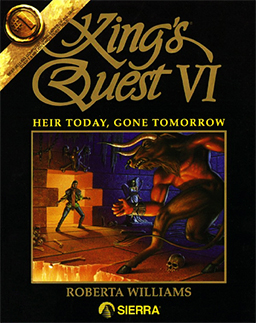 King's Quest VI (1993) is still one of my all-time favorites. You're Prince Alexander, a dude who ends up shipwrecked on some trippy, magical islands (presumably as a result of the King's Quest 5 finale, although I can't guarantee that). Your girlfriend is being held hostage in a tower on one of the islands and you have to figure out how to save her. This was the first game I solved completely by myself (and the help of some kindred spirits on the internet). The graphics were pretty solid, and the puzzles were really creative. You have to trick a series of gnomes into thinking you don't exist, outwit Death, navigate through catacombs while successfully avoiding a minotaur, escape from being sacrificed by druids.. this game had it all! Also my favorite soundclip from any game, heard if you drown in the River Styx.
 Titanic: Adventure Out of Time is possibly one of the most underrated games of all time. For 1996 the graphics were top-notch. The game had two modes: 1) An adventure game where you have to go back in time and prevent the Titanic from sinking (pro-tip: you can't). 2) A non-game where you could simply wander around the ship and look at stuff on the Titanic. Evidently Cyberflix created a pretty accurate representation of the actual Titanic; after playing for a while, you really get to know your way around the ship, which is pretty freaking awesome when you think about it. This game is full of win, and probably would still hold up today.
 Riven (1997) is the first sequel to Myst, and in my estimation, a better game. The plot, although still fairly incomprehensible, is slightly easier to navigate in terms of course of action. Like in King's Quest 6, you're stuck on a series of crazy islands with all kinds of weird technology. The graphics and music are gorgeous and the world is completely enveloping. If I had to live in a video game world, it would definitely be Riven's. The final series of puzzles was pretty much unsolvable unless you cheated, which of course I did, but still probably bragged at the time about how I didn't.
 Shivers (1995). This game was way too effing scary for a 12-year-old girl. You're trapped in a museum full of haunted and paranormal shit from around the world, some of which has murdered the proprietor. There are also these "ixupi" demons that pop out of nowhere and kill you violently if you make a misstep. In retrospect, it was probably a pretty sweet game, but I remember getting seriously creeped out by it and not being able to sleep well while playing through it.
These games are a pretty good sampling of what shaped my early years of PC gaming. There were others scattered in there, but none that left a lasting impression like this bunch.
Up next, 2000-present: Entering the age of 3-D.
My parents got me started on our old Apple IIe playing a Sesame Street coloring book game. Some of my very first memories are of not understanding why the (greyscale) pictures I printed out didn't look like the colorful 16-color pictures on the screen. Roughly 22 years later I still find myself occasionally asking that same question.
A few years after the Apple IIe became obsolete we upgraded to a system that could handle REAL graphics. Thus began my adventure game addiction...
These games are a pretty good sampling of what shaped my early years of PC gaming. There were others scattered in there, but none that left a lasting impression like this bunch.
Up next, 2000-present: Entering the age of 3-D.
Thursday, July 22, 2010
Night Terrors
Thanks to the subject of this post I am wide awake at 4:30AM. It's such a bizarre problem that I felt compelled to finally write about it, even though it's likely to make me seem like an insane person.
So what's a night terror? Like a bad nightmare, right?
Not even a little. Imagine waking up from sleep, completely aware of your surroundings and able to interact with your environment but having the sudden overwhelming sense of impending doom. Something terrible is about to happen. That "something" is a total variable; you're 95% lucid and have no idea which 5% is not real.
That nebulous 5% can manifest itself in any way imaginable. In a split second, the brain makes up sometimes incredibly elaborate backstories for what is about to "happen". If I could somehow channel the creativity of the night terror center of my brain, I'd probably be a highly successful author or clown or something.
Here are some of the ways my night terrors manifest themselves:
The way that night terrors substantiate themselves (at least for me) seems to be completely unrelated to anything- not something that happened that day or what I was just dreaming about. My previously peacefully-sleeping brain just suddenly spazzes and says "JESUS CHRIST LIZ, WAKE UP AND SAVE YOURSELF FROM THIS THING". And I do. And after a few minutes, my normal logical self takes over and I feel really really stupid for not knowing that I was having a night terror. Especially if I manage to lock myself out of the room in the process.
But at the time it always seems so real, and even if I can actively tell myself I'm having a night terror, it's SO vivid that I end up convincing myself that this time it's real. I knew it. There is definitely a giant spider in the corner this time.
Other people's night terrors often involve "shadow people" or "demons" or sleep paralysis and frankly I am effing thrilled as hell that mine do not. That is way too intense. I'll gladly stick with my toxic-fume spewing bottle of hairspray, thank you.
Update: 10/04/10
Unfortunately, depending on what your brain has made up, there is the opportunity to seriously injure yourself or others near you. The worst I've done is bruise myself up by throwing myself on the floor to avoid the collapsing ceiling; however, recently, I experienced a night terror while having a migraine. My brain convinced me that this migraine was being caused by a foreign object in my head and I needed to get it out of there ASAP. Fortuitously, I just had moved my scissors away from my bed and to the other side of the room earlier that night. There's no telling how that might have ended had the scissors been easily accessible before this night terror faded.
So what's a night terror? Like a bad nightmare, right?
Not even a little. Imagine waking up from sleep, completely aware of your surroundings and able to interact with your environment but having the sudden overwhelming sense of impending doom. Something terrible is about to happen. That "something" is a total variable; you're 95% lucid and have no idea which 5% is not real.
That nebulous 5% can manifest itself in any way imaginable. In a split second, the brain makes up sometimes incredibly elaborate backstories for what is about to "happen". If I could somehow channel the creativity of the night terror center of my brain, I'd probably be a highly successful author or clown or something.
Here are some of the ways my night terrors manifest themselves:
- (Most common) Giant spider in the corner. Can't actually see it, but I know it's there, lurking and ready to pounce if I move at all.
- (Second most common) Any red LED light in the room = camera. Someone's gone and installed cameras in my room, or outside the window and they're watching me. Creeps.
- (Third most common) I've somehow accidentally woken up in somebody else's room. Some stranger's room. Crap, I'd better get out before they realize I'm sleeping in here! So I get up and leave.
- Oh shit, the ceiling's about to collapse! Better throw myself on the ground so I don't get squashed!
- Uh oh, that bottle on my dresser is spraying out toxic fumes. I need to let everyone in the house know they need to leave so they don't breathe in the fumes!
- (Hearing someone talking in the other room) O.M.G. I've heard this conversation before... I'm trapped in some kind of repeating time loop... HELP!
- That's not a bar on the window, it's a rope... there's a SWAT team climbing outside the window, poised and ready to break in at any second!
- Someone's built a deadly Rube Goldberg machine that's triggered by any motion I make. If I move at all, it will set off a chain of events that will lead to my demise!
- Oh fuck, that sound outside is some kind of nuclear weapon about to land on the house! Not much I can do about that one...
- And myriad others, often too abstract to really understand once I've come-to.
The way that night terrors substantiate themselves (at least for me) seems to be completely unrelated to anything- not something that happened that day or what I was just dreaming about. My previously peacefully-sleeping brain just suddenly spazzes and says "JESUS CHRIST LIZ, WAKE UP AND SAVE YOURSELF FROM THIS THING". And I do. And after a few minutes, my normal logical self takes over and I feel really really stupid for not knowing that I was having a night terror. Especially if I manage to lock myself out of the room in the process.
But at the time it always seems so real, and even if I can actively tell myself I'm having a night terror, it's SO vivid that I end up convincing myself that this time it's real. I knew it. There is definitely a giant spider in the corner this time.
Other people's night terrors often involve "shadow people" or "demons" or sleep paralysis and frankly I am effing thrilled as hell that mine do not. That is way too intense. I'll gladly stick with my toxic-fume spewing bottle of hairspray, thank you.
Update: 10/04/10
Unfortunately, depending on what your brain has made up, there is the opportunity to seriously injure yourself or others near you. The worst I've done is bruise myself up by throwing myself on the floor to avoid the collapsing ceiling; however, recently, I experienced a night terror while having a migraine. My brain convinced me that this migraine was being caused by a foreign object in my head and I needed to get it out of there ASAP. Fortuitously, I just had moved my scissors away from my bed and to the other side of the room earlier that night. There's no telling how that might have ended had the scissors been easily accessible before this night terror faded.
Subscribe to:
Posts (Atom)
